Hey all,
I’m Marcin, the Co-Founder of Spacelift. I’ve seen the beginnings of some major shifts in the way infra and platform teams work with dev teams. Here’s why I feel the handoff is collapsing (and why that’s a good thing).
If you’ve ever watched a dev team and a platform team try to ship something together, it can sometimes feel like watching a relay race where everyone keeps dropping the baton, nobody trained for the event, and the track was designed by a compliance team that’s never heard of sports.
Someone eventually crosses the finish line, but no one is celebrating.
For years, we’ve acted as if the goal was simply to run the relay faster. Faster provisioning. Faster CI/CD. Faster cloud.
But speed was never the real bottleneck. It was the handoff.
Today, the typical workflow looks something like this:
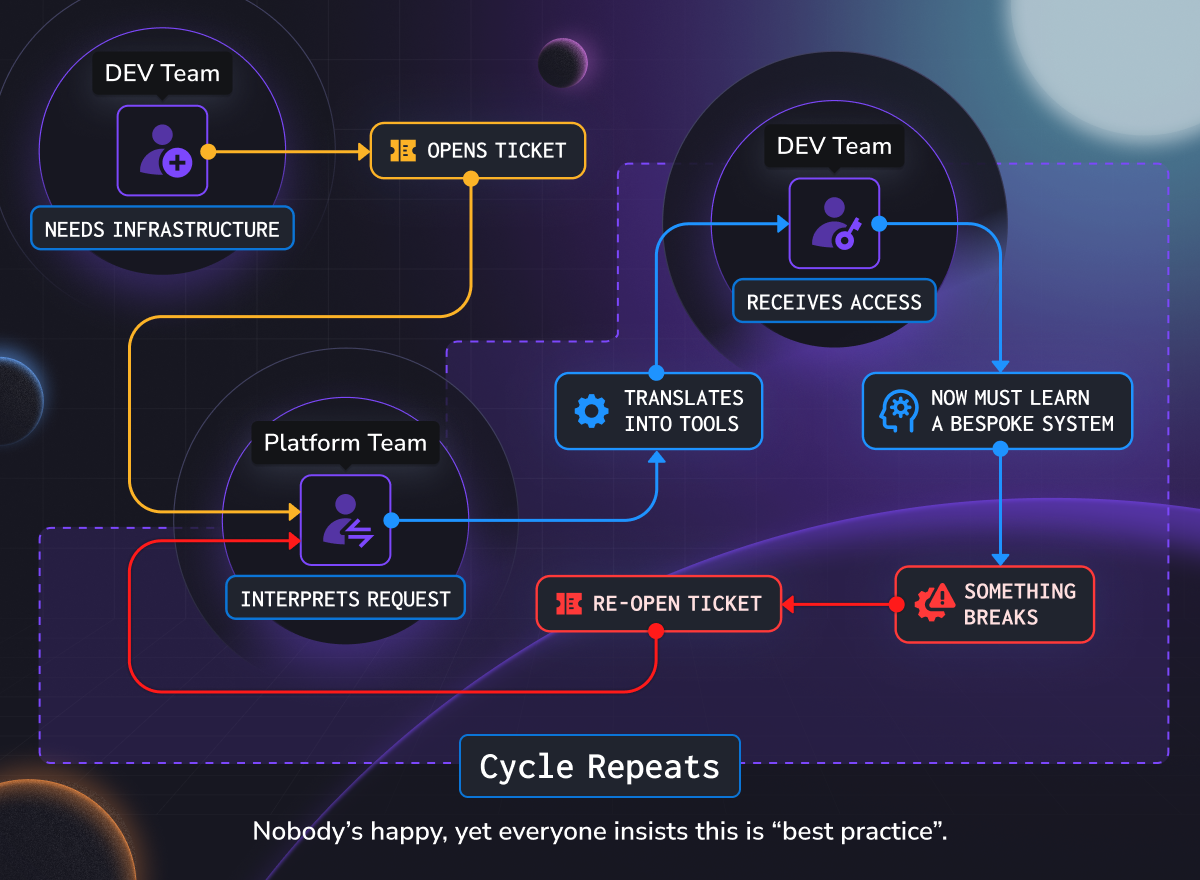
It works, technically. But it’s slow, brittle, and makes every team feel like they’re the ones doing it wrong.
We’re about to see this entire model collapse because the underlying coordination problem is disappearing.
Here’s how I see it all unfolding:
1. AI Democratizes Capability (Without Replacing Expertise)
AI isn’t turning developers into platform engineers or vice versa. What it is doing is removing the penalty for not being one.
A front-end engineer who just wants “a small Postgres instance, same as payments but without the terrifying parts” shouldn’t have to spelunk through Terraform modules like they’re deciphering an ancient inscription.
And what does the process look like today to get this done? A Slack message → a ticket → a 3-day wait → a learning curve.
In the new model of collaboration, AI interprets the intent, applies platform guardrails, and provisions safely—without forcing the dev to manually translate requirements into code.
AI collapses the “I can’t do that” gap by giving people superpowers in adjacent domains.
Expertise still matters. But now it’s leveraged, not bottlenecked.
2. Platform Teams Evolve From Gatekeepers to Curators
Today, platform teams operate like border control: “What are you declaring? Is this approved? Do you have the right forms?”
Tomorrow, that posture won’t survive, and frankly, everyone is relieved.
Instead of asking “What infrastructure do you need?” they’ll ask:
Platform teams will spend their energy curating the patterns that keep everyone safe: policies that define what “good” looks like, paved paths that teams naturally follow, and an ecosystem where developers can move fast without stepping into a governance bear trap.
And they’ll say goodbye to an endless ticket queue.
3. Tickets Give Way to Conversations
The ticketing system’s best quality is that it’s a necessary evil we all love to hate. That makes it easier to replace.
Simple requests will flow through conversational interfaces backed by MCPs and policy engines that understand context.
More complex ones will become real-time design conversations rather than slow-motion misunderstandings spread across eight Jira comments and three PDFs.
Tooling fades into the background. Mismatched vocabulary disappears. Everyone finally speaks plain language.
4. Operations Stop Being a Separate Universe
Right now, infrastructure and operations behave like divorced parents who only speak through their children.
Provisioning happens here. Monitoring happens there. Incident response happens somewhere else entirely, usually at 2 A.M.
In the new model, infrastructure comes with operations baked in:
Dev teams don’t inherit raw infrastructure. They inherit infrastructure with an opinion, shaped by platform expertise and enforced by policy.
This reduces firefighting, reduces inconsistency, and—critically—reduces the late-night “who owns this?” Slack messages. The Shift is Not Technical. It’s Relational
Yes, the tooling is evolving. And yes, AI is getting better. But the real transformation is the relationship.
Dev teams stop feeling dependent. Platform engineers stop feeling like bottlenecks. And everyone gets back the energy previously spent deciphering tickets written at 4:59 P.M. on a Friday.
Once the handoff collapses, collaboration stops feeling like a relay race and starts feeling like a shared project again.
And for the first time in a long time, everyone gets to run at their own pace—without dropping the baton.
|

